#Rule 2021 : Cure for 2020

Rule 2021: Cure for 2020

As horrible as 2020 was, we started 2021 in almost a worse position. The divide between people has grown beyond politics into distrust of even friends and family. I’ve seen families splinter, not because they disagree, but because they’ve forgotten how to disagree. The days of having a beer and agreeing to disagree are gone. Now, every issue is defining. How you feel about the former president, the new president, masks, vaccinations, and lockdowns puts you into a “camp.” And the way information flows now—customized to our own bias—means other viewpoints aren’t just dismissed, they’re shouted down before they’re even heard.

Why? I don’t think this comes down to one man, a disease, or a political party. The root cause is the way we live and communicate with one another.

When I was in high school—back in the prehistoric era, hanging out with Fred and Barney—we had disagreements too. Arguments took time to build and time to resolve. If I fought with my girlfriend, the earliest I could pick it back up was hours later on the kitchen phone. And that phone only stretched six feet from the avocado-green wall mount. Privacy was impossible, and conversations had limits.

That slowness mattered. Sometimes I had to wait until the next day, sometimes weeks. In the meantime, I talked to friends and family, got advice, and usually—about 24 hours later—it dawned on me that I was the asshole.

In college, communication slowed down even more. My girlfriend and I wrote letters or spoke once a week, because long-distance calls cost too much. Writing meant thinking. It meant tearing up drafts on the walk to the post office, deciding what I really wanted to say. Insults in writing were permanent, so I learned patience and reflection.

That’s the problem today: communication is too easy and too fast. Every thought can be broadcast not only to the person you’re arguing with, but to dozens—sometimes thousands—of people within seconds. We’ve been taught that every feeling deserves to be heard. But just because you get 100 likes doesn’t make you Aristotle. Hell, it doesn’t even make you Lindsay Lohan. Thoughts aren’t valuable because they’re popular—they’re valuable when they’re reflective, empathetic, and real.

As I write this, it’s taken me three days, with edits and rewrites along the way. Changing my mind is part of the process. It’s healthy. We should allow ourselves to make mistakes and grow, not double down on our worst impulses.

Honestly, I can’t imagine what kind of bigger asshole I’d have become if Facebook, Twitter, or Instagram had been around when I was 19. The certainty with which I’d have spewed stupidity is frightening. Add a few dozen likes and comments egging me on, and I’d have built a fortress of ego instead of growing up.

Today, it feels like the world is run by 19-year-old Bobs with smartphones, validating each other through endless contests of outrage. Watching the protests and riots at the Capitol, I noticed not just the crowd but the glow of their phones—people live-streaming, podcasting, FaceTiming every unfiltered thought. And the media? Both sides turned what they saw into instant opinion pieces, crafted in about 35 seconds of thought. It’s no longer about being right or even being reflective. It’s about being popular, validated by likes, comments, and ratings.

We’ve become monkeys with guns—firing opinions without aim or thought for the consequences. What wins isn’t character, as Dr. King once dreamed, but follower counts.

So what’s the cure? I think it starts by slowing down communication—going back to that six-foot phone cord. Personally, I’ve begun taking social-media-free days. I’m aiming for “no cell phone Sundays” and other built-in breaks. I also follow a two-hour rule before responding to posts. If I still feel it’s worth saying after two hours, I give it two more. Most of the time, I let it go.

Yes, it’s ironic to express this through a blog. But unlike social media, this process forces me to pause and edit over days. Most of my drafts never get posted at all, which is probably for the best. Not every thought is worth sharing—and that’s the point.

I’ve also stopped watching CNN and FOX, turning instead to written reporting. Reading forces reflection, even when bias is present. It’s slower, and that’s the cure: slower communication, slower opinions, slower reactions.

So here’s my challenge: try building in a pause. Take one day off social media. Wait two hours before responding. Write instead of posting. Reflect instead of reacting.

We need a way out of this madness. And maybe it starts by putting the guns down and letting the monkeys breathe.

Love, Dad
Posted in Uncategorized | Leave a comment

Rule#74: Motorcycle Paradox

Rule #74: Motorcycle Paradox

As an insurance geek and underwriter, I don’t get many chances to teach my kids life skills from my career. I can’t show them how to cut a perfect dovetail joint, rebuild a carburetor, or tune up an old Chevy. Most of what I do is behind a desk, heavy on spreadsheets and contracts. Not exactly the stuff kids find exciting.

But when the pandemic came along, suddenly I had the chance to teach them about something I know well: risk.

As an underwriter by trade, I spend my career measuring risk, deciding which risks to accept or decline, and how to price the assumption of that risk. The challenge isn’t to avoid risk altogether — that would be impossible. The real challenge is to take the right risks at the right price.

Take cars, for example. The best way to avoid liability risk is to keep the car in the garage forever. If you never drive, you can’t get in an accident. But then what’s the point of owning a car at all? A car is built to go places. Hiding in the garage isn’t really an option.

Every parent of a new 16-year-old driver knows the knot in your stomach when your child pulls out of the driveway alone for the first time. There’s no way around it: letting them drive means accepting the risk that something could happen. And yet, it’s also the only way they’ll grow, learn, and live their lives. Risk is part of living.

The same is true of big societal risks. When COVID arrived, people argued endlessly about how much risk to take. Was it safer to keep kids home from school and work? Of course. But the longer we hid in our garages, the smaller and darker those garages began to feel. The truth is, life cannot be lived without risk.

That’s why underwriting is really a process of understanding. The better we understand the risk, the better decisions we can make about it. And that requires accurate, unbiased information. Bad information leads to bad decisions — in insurance, in health, in life. I’ve seen it in my own industry: disinformation once paralyzed coverage for sexual misconduct claims, environmental liabilities, and construction defects. At first, panic ruled. But once the facts came out and the numbers were better understood, common sense returned to the market. The same lesson applies everywhere: listen broadly, but believe only what you can verify. People have biases. Truth matters.

Which brings me to the Motorcycle Paradox.

Nothing has more conclusive data than the effectiveness of seat belts in preventing death and injury. That data is so overwhelming that every state in the U.S. mandates seat belt use. Yet at the same time, there are over 8 million motorcycles on the road — none with seat belts — and in 31 states, adults are legally allowed to ride without helmets. How can that be?

Why do we mandate absolute safety in one case, while tolerating enormous risk in another?

The answer is simple: society accepts that people know the risks of riding motorcycles, and are willing to assume them. We don’t outlaw motorcycles, skydiving, rock climbing, or even unhealthy food. Freedom allows for risk — and risk allows for life.

That’s the paradox. We can’t always make risk “fair” or consistent. What we can do is make our peace with it.

I wore a helmet every time I rode a motorcycle, not because I was angry at those who didn’t, but because I understood my own risk. In the same way, I wear a mask in crowded places because I’m 60 and diabetic. That’s my choice. I don’t waste my time fuming about people who make different choices. Life in a free society comes with risk, and also with tolerance.

That’s what I want my kids to learn: be good underwriters. Don’t be paralyzed by fear, and don’t assume reckless, unnecessary danger. Learn how to weigh the risk, understand it, and make thoughtful choices. I’d wrap them in bubble wrap if I could, but that’s not living.

So drive safely. Take reasonable precautions. But don’t stay locked in the garage. Life goes too fast not to get on the motorcycle once in a while — just make sure you wear the helmet.

Love, Dad

Posted in Uncategorized | Leave a comment

Rule #572: House divided against itself cannot not stand

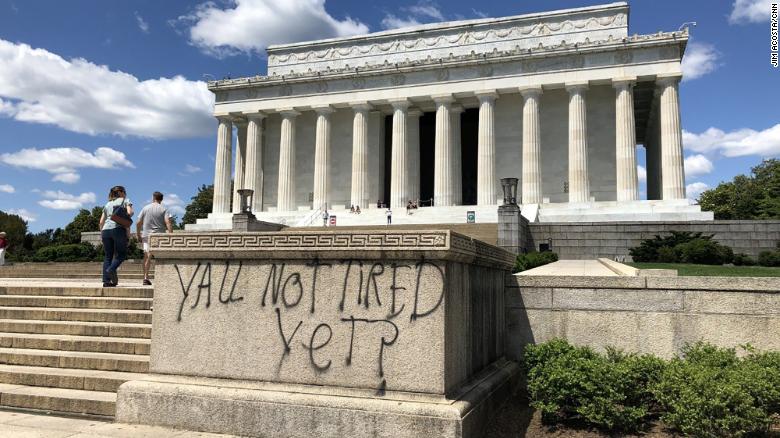
Graffiti from Saturday night protests on Lincoln Memorial in Washington.Rule #572: A house divided against itself cannot stand.

“In this temple as in the hearts of the people for whom he saved the Union, the memory of Abraham Lincoln is enshrined forever.”

This sickens me. The stupidity, the hatred, the blame, and the insanity—it all sickens me.

The needless deaths of Eric Garner and now George Floyd sicken me. Yes, they were allegedly committing crimes, but not capital offenses. The force used by police has to be kept in check. This was murder and should be treated as such. Police reform, discipline, and training are all needed. We need to trust our police force again.

We are living in a country that is focused on blame and hate. We have lived through the crisis of COVID-19 and came out of it not united, but more divided. Everyone is digging into their positions and piling barrels of gasoline around their foxholes. With the riots over the last few nights, we have now begun tossing lit matches at each other. The fires will only get bigger and more deadly.

We are fighting over whether we wear a mask or not, or whether we fly a Trump flag. The hate for our fellow citizens is overwhelming. We have stopped seeing ourselves as Americans, instead dividing into groups that are either with us or against us. We are distrustful of everyone, because they are distrustful of us. We have lost empathy. As looters are arrested, others are bailing them out.

This isn’t about Antifa, white supremacists, Donald Trump, Joe Biden, or anyone else you care to blame—this is about a house divided against itself. We have begun to look at each other as something “other,” as though our opinions make us less intelligent, less evolved, less human.

The people who are looting must feel that they are the underclass and as such can take what is not rightfully given. If you no longer see the rich—and often white—as part of your world, then it no longer feels like stealing, because in their world you have no rights.

Dr. M. Scott Peck, in his book People of the Lie: The Hope for Healing Human Evil, defines evil as “militant ignorance.” The people looting are not dumb or less than human; they are people who have lost empathy for others. They are not stealing from Foot Locker to feed their families or to protest an act of police brutality. They are stealing because they have numbed their consciences and rationalized evil behavior. They no longer have empathy for the rich, the white, the privileged, or the police—to them, stealing from them is not wrong because they don’t care about them.

This “scapegoating” of other groups (as Dr. Peck calls it) is necessary for evil to exist. I watched a video of a woman being beaten by looters in upstate New York. To do this, they must have lost the ability to see from the victim’s viewpoint, becoming completely narcissistic. Watching that video, like the video of Mr. Floyd being choked to death, is to witness evil.

We must find justice for George Floyd. We must have empathy for the pain his family and friends are enduring, and we must change through listening.

We must also find justice for those whose homes, businesses, and even lives have been taken by these looters. Both must be done swiftly and decisively.

We have stopped listening and have developed a covert intolerance to criticism—and that is the pathway to evil. Something is seriously wrong with our society, and we need to find pathways back to caring about each other. We can disagree without hate.

Love, Dad

Posted in Uncategorized | Leave a comment

Rule # 117 : Trust but Verify

Rule #117: Trust but Verify

You kids know that I tend to tell my stories and make statements that appear to be based on fact, but are colored by my opinion. My dad used to do this at the dinner table—he’d quote aspects of social studies, math, and science as fact, and do it in such a convincing way that you left the meal certain he was telling the truth.

For the most part he was, but when the facts didn’t support his arguments, he’d slightly change them. For better or worse, I inherited this unique skill set—creating my own reality for the benefit of a good story.

It was a lot more fun up until the introduction of the World Wide Web in 1990, and even more fun before Jerry Yang launched Yahoo in 1994. Instead of requiring a trip to the library to fact-check me, you can now test all the stories with a simple search. This makes telling a good story increasingly hard.

That was bad enough, but then the information we had available started to include intentionally misleading or wrong facts. Trusted sources of information were being eaten up by “user-created” data in places like Wikipedia. Now it’s possible to be fact-checked with incorrect or intentionally false information that looks real.

I love satirical websites like The Onion with their “made to look real” stories, and I find it hysterical when “real” news outlets pick up one of their stories and re-report it as fact. Unfortunately, this has started happening weekly, not just a couple of times a year. That kind of laziness in fact-checking by reporters is not as funny—and often dangerous.

Take, for example, the National COVID-19 team saying that deaths from COVID-19 could be as high as 240,000 people. Pretty scary.

But let’s put that number in perspective. In 2017—the most recent year with complete data—there were 2.8 million deaths in the U.S. The top causes were:

  • Heart disease: 647,000

  • Cancer: 599,000

  • Accidents (car crashes and the like): 170,000

On top of that, respiratory illnesses accounted for 160,000 deaths, and diabetes for 84,000.

So here’s the context: if all 240,000 projected COVID-19 deaths were people who otherwise would not have died that year, it would represent about an 8.5% increase in the national death rate. But health officials pointed out that many of those deaths would overlap with people already vulnerable to other conditions. The net effect might be closer to 50,000–75,000 additional deaths—still serious, but not as catastrophic as the raw number makes it sound.

The point of all this is that in this world of fluid information and “storytellers” who look like credible sources, we need to adopt a trust but verify position on everything we read or hear.

When I took a journalism course (back when there was journalism), we were taught that every story needed to have credible sources, and those sources had to be verified. Check and re-check, and never believe anything as fact without proof from multiple sources.

In this new age of COVID-19—and whatever crisis comes next—we need to behave like good journalists: checking sources, verifying, and re-verifying. I’ve learned through this crisis not only not to trust any single source on its own, but also not to trust my own instincts. So it’s up to each of us to be our own guardian of the truth, searching for it and not just for an answer that agrees with our opinion.

With that said, I need you to give your old man a break, just as I did with your grandfather. Sometimes stories are better with the facts changed a bit—and far more interesting. The fish grows bigger with each retelling, but it’s far more exciting to catch. There’s a difference between humoring your dad’s stories and relying on news from a cable channel.

So remember Rule #117: trust, but verify—whether it’s your old man’s fish story or the evening news.

Love, Dad

Posted in Uncategorized | Leave a comment

Rule # COVID 19- Five Lessons From an Epidemic

COVID-19: Five Lessons From an Epidemic

I’ve been through the typical ups and downs of life that we all experience. I’ve failed a course, been fired multiple times, been divorced, and lost at virtually every athletic endeavor possible. In short, I’ve screwed up a lot. But although I’ve failed often, I’ve learned that with each failure comes a lesson. And if I pay attention to those lessons, I can avoid repeating the same mistakes—while finding entirely new ones to make.

With COVID-19, I know I made mistakes, too. And from them, I’ve taken away a few lessons I want to pass on to you, my children.

1. Prepare for the unexpected

You’d think that, living on the water in a hurricane zone, preparation for disaster would have become second nature. It wasn’t. We scrambled at first to catch up on staples and medical supplies, and we weren’t ready for a two-week-plus quarantine. Going forward, I don’t plan to hoard or overbuy, but I do plan to always keep at least two weeks’ worth of essentials on hand—year-round, not just during hurricane season.

2. Limit news consumption

I’m a news junkie. I like hearing all sides, from the most conservative to the most liberal. But when crisis turns into a 24/7, multi-week event, it’s no longer news—it’s noise. The overload breeds panic. Cable news makes us anxious, and the internet makes us irrational. Remember the toilet paper hoarding? Or people eating fish tank cleaner? That’s what happens when rumor spreads unchecked. My advice: no more than two hours of news updates a day, even in the worst crisis. More than that, and fear is all that’s left.

3. When you don’t know what to do, help someone

This has been one of my life’s mantras and something I’ve tried to teach you since you were small. In a crisis, our instinct is to turn inward and worry about our own security. But that inward focus only tightens the knot of fear around our hearts. The antidote is kindness. Helping a housebound neighbor, calling someone who feels alone, or simply being kinder in everyday exchanges—these are the things that break the grip of fear. Even in a “shelter in place” world, technology gives us ways to connect. Kindness is more contagious than COVID-19. Spread it.

4. Don’t let stress turn you into an asshole

As days stretch into weeks and months, it’s easy to let stress twist us into the worst version of ourselves. We become short with the people we love, or dismissive of those reaching out. It’s human nature, but it’s also the ugliest part of being human. I remind myself that I’m dealing with people I love and care about, and that arguments born of stress hurt them most of all. Yes, you’re stressed—but “suck it up, buttercup.” Put on a kind face for the people who matter. At least once a day during this pandemic, I’ve caught myself slipping into asshole mode. It’s a constant battle, but one worth fighting.

5. Sweat the small stuff

There’s a saying: “Don’t sweat the small stuff—and it’s all small stuff.” I disagree. In a crisis, the small stuff is what matters most. The board game you pull out and play with your kids. The “good” bottle of wine you open at dinner to toast your spouse. The extra hug, the extra kiss goodnight. It isn’t the big things that carry us through; those tend to sort themselves out. It’s the little things—the gestures of love and connection—that help us not only survive but thrive.


Kids, this will end. And another crisis will come along—it always does. When it does, remember two things from your dad:

  1. You will get through this.

  2. You are loved.

That’s all you really need to know.

Love,
Dad

Posted in Uncategorized | Leave a comment

Rule #57- Nothing takes the Place of Persistence

Rule #57 – Nothing Takes the Place of Persistence

“Nothing in the world can take the place of persistence. Talent will not; nothing is more common than unsuccessful men with talent. Genius will not; unrewarded genius is almost a proverb.” – Ray Kroc, Founder of McDonald’s

As I write this, we are in the 10th day of a nationwide shutdown caused by the COVID-19 outbreak. It has been a challenging time for families, businesses, and individuals — virtually no one is untouched by the impact of this pandemic. I’ve been thinking about what advice I could give my kids that would bring comfort and hope, and I keep coming back to one word: Persistence.

Persistence has been the common thread in every personal and professional success of my life. Early on, I realized I wasn’t the brightest, the best looking, or the most athletic. But I discovered something more valuable: I could outlast others. I could stay steady in the middle of chaos, keep moving when things got tough, and with practice, I learned to thrive in the storm.

It’s not the will to win that matters most — it’s the will to endure. Persistence is about pushing forward even when life is unfair, unpredictable, or painful. It’s the grit to expect adversity, face it head-on, and refuse to let it dictate your future.

Looking back, persistence is what carried us through every big leap — moving to North Carolina for a new job, starting over in Hawaii to earn a first Master’s degree, relocating to Ohio, Harrisburg, or St. Petersburg. Each move required grit. Each challenge tested us. And each time, you showed persistence and kept moving forward. That’s what matters. Because when we stop pushing ourselves, fear and discouragement creep in. But when we keep stepping forward — even one small step at a time — we find our way through.

This pandemic is another one of life’s adversities. No one can promise you won’t get sick, but I can promise this: you can handle whatever comes. Use this time wisely. If you’re under a stay-at-home order, clean, reorganize, read, plan, and prepare. Don’t think of this as a stop sign — it’s a green light to improve, adapt, and get ready for what’s ahead.

I’m not a conspiracy guy. The simplest answer is usually the right one: we have a nasty, highly contagious virus, and we need to do safe things. Stay home when possible, avoid crowds, wash your hands, and follow the rules. Be careful, be thoughtful, and respect the law — but through it all, keep moving.

This moment will pass. Soon, it will be just another story in your life, not a roadblock. So focus on persistence — in your work, your relationships, your growth. The best is yet to come, and you are on the right path.

COVID-19 doesn’t get the last word. Persistence does. Keep moving forward.

Love, Dad

Posted in Uncategorized | Leave a comment

Rule #177: Fear of Toilet Paper

Rule #177: Fear of Toilet Paper

Fear is useful. It keeps us from doing stupid things that will kill us — like messing with alligators or answering the door for a pair of Jehovah’s Witnesses on a Saturday. If my kids get a creepy feeling about a person or place, I tell them to trust that judgment and steer clear. Fear often nudges us toward decisions that keep us safe.

But fear is complicated. Sometimes it’s something we must overcome with courage. I’ve talked with many people who served in the military; in the worst moments they were terrified, but because of honor and commitment they moved forward anyway. They say they were afraid — only a fool would not be — yet they turned that fear into heightened awareness. Fear can be the caffeine that wakes us up when we need it; digested and used, it can be powerful.

Other times fear is irrational. It makes us act stupidly. When I lived in the Northeast it was snowstorms — every low off the coast was going to bury us. And for some reason if you bought eggs, milk and bread you felt more prepared. I call it the French toast syndrome.

In the South it’s hurricanes — every low off Cuba looks like the end of the world. Media feeds this: fear, like sex, sells. The more frightened viewers are, the more they watch, and the more people hoard and act wildly.

James Carville’s mantra, “Never let a good crisis go to waste,” has become a business strategy for our 24-hour news world — from Fox to CNN to MSNBC, even the Weather Channel. When we catch weather reporters standing in a hole to make flooding look worse, who can we trust? The world feels unmoored.

And yet — sometimes the storm does hit, the hurricane does make landfall, and the virus does kill people. Odds don’t comfort us when it’s our turn. Whether there’s a 10% chance of infection or a 3% mortality rate, our minds are terrible at measuring risk. We’re the same species that believes the next scratch-off will be a winner and that somehow the worst will land on us. When news outlets amplify fear, how do we find a sounder path?

Look at the empty toilet paper aisle and take a breath. We are not dying today. We have time to think and decide. We don’t need to grab every chicken off the plate — leave some for others. Hoarding turns sensible preparation into end-of-the-world madness. No one is going to run out of toilet paper unless some people load their minivans with 800 rolls.

I live on the water in Florida, so every April I check the generator, stock four or five cases of water, and add some canned goods — I expect storms. For the COVID-19 crisis, we’ve stocked the cabinets and doubled down on handwashing and avoiding face-touching. I’m not hiding with a cache of ammo; I’m being prudent and breathing. Even as a 60-year-old with several underlying conditions, I expect to be alive come May. Our family’s 36 rolls give us a small edge getting through this.

Make rational, thoughtful decisions and don’t react to every breaking-news alert. Half the world tells you to panic; the other half says there’s nothing to worry about. No, I’m not booking cruises right now (I know I’ll take one in the future), and no, I’m not traveling to northern Italy this year. But I’m going about my days largely unaffected by the hysteria and will travel for business when necessary. Assess risk for yourself — based on as many facts as you can get and as few talking heads as possible.

Remember: breathe, think, question everything — and yes, 36 rolls are enough for 14 days of quarantine.

Love, Dad

Posted in Uncategorized | Leave a comment

Rule# 313: purge ofter

Rule #313: Purge Often

When we moved to Florida in 2017 we decided to get rid of everything we didn’t use. I filled two loads of a 40-yard dumpster and ran a massive garage sale. I thought I was making good progress.

I hadn’t even scratched the surface.

The problem was compounded by moving into a 7,200 sq ft house that didn’t force hard decisions. I could keep life’s “treasures” without consequence — things that will become my children’s burden to haul away when we’re gone. Fortunately we did collect a fair amount of valuable art and coins, which will make the eventual clean-up feel more like a treasure hunt. But there will still be yards and yards of useless stuff.

My divorce 20 years ago purged a lot of my things, and moving to Florida helped again, but I still accumulate useless stuff — as useful as an old cheese grater. The real clutter isn’t the stuff; it’s the emotional baggage we carry. We don’t force change because, frankly, it’s just too damn hard. Comfort is easy, and that’s why we keep the old dish towel and the broken Halloween decorations. It’s why we accept lives that stop challenging us.

Florida was scary for me. At 57 I moved away from family and friends into a little Jumanji of snakes, roaches, cane toads, and hurricanes. Yes, it’s a beautiful house on the water — and yes, it’s still friggin’ Florida. But Florida energized me. It forced me to meet new people and to work at keeping old friendships. It made me a better, more interesting person. I have regrets, sure — but as Frank Sinatra said, they’re “too few to mention.”

Now, as I approach my 60s (and yes, that’s a risky bet), I’m trying to purge more than just things. I want to shed emotional baggage and take risks I couldn’t afford in my 30s — when I was too poor, too afraid, or too focused on my kids. I want my 60s to bring more challenges and change than my 40s did. I reluctantly accept that I will one day die, and that acceptance gives me the freedom to put it all on black and laugh if it comes up red. The true secret is that living is so much more important than winning.

Remember Eevee’s “four spins to glory” on the roulette wheel. Even if her all-or-nothing bets hadn’t worked out, she would have had one hell of a story. Stories last longer than money.

My good friend Tim is leaving a job where he had the best results in the company. He’s not leaving because he failed — he’s leaving because the ceiling elsewhere is a little higher. Yes, he could fail. But by stepping into the unknown he gives a big middle finger to complacency and chooses to be different. I admire that. Even if he stumbles, he will have won.

I’m not saying jump out of every plane or ignore sensible risk. You have families, retirement plans, kids to get through college. But once in a while, fill up the dumpster and jump without looking. It’s supposed to be scary — scary leads to the best stories.

And you all know how I love my stories.

Love, Dad

Posted in Uncategorized | Leave a comment

Rule #54: Boys will be Boys

Rule #54: Boys Will Be Boys

As the father of three wonderful girls and the grandfather of the awesome Hailey, I am a strong supporter of the #MeToo movement and of the societal protections that give those who need it most a voice. There is never an excuse for abusive behavior, nor for using power to take advantage of others. The pendulum of fairness was long out of balance, and this renewed awareness has given many people who were damaged the strength, support, and acceptance they deserve. It’s long overdue—and it must continue.

At the same time, as the father of three wonderful boys, I’ve reflected on what I taught them and whether my approach holds up in this new cultural moment. A recent PSA from the Joyful Heart Foundation—an organization I admire—got me thinking. In it, male celebrities repeat the phrase “boys will be boys” before the words ENOUGH appear on screen, calling for cultural change.

That struck a chord with me, because I raised my boys with that phrase in mind—but not in the way the PSA condemned. When my sons fought, I didn’t rush in to settle their arguments. Instead, I let them work things out, sometimes physically, as brothers do. I didn’t throw a knife into the fight, but I gave them room to resolve their problems. My belief was simple: I wouldn’t always be there, so they needed to learn independence and resilience.

I remember one incident when Andrew was about 10. His Catholic school principal, a Sister of Mercy, called me in after Andrew got into a fight on the playground. She explained that a smaller boy had been harassing him for weeks, teasing and poking at him. One day that boy hit Andrew in the back of the head with a kickball. Andrew snapped, picked him up, slammed him against the fence, and yelled, “Leave me alone!” The boy, frightened, ran to the teachers.

The Sister told me Andrew was a good, kind child—and that he needed to learn to stand up for himself. She punished the other boy with detention but let Andrew off with a warning. “Boys will be boys,” she said. Then she added that when the other boy complained, she told him, “I know what you’re doing, and next time I won’t protect you.”

Was Sister wrong? I don’t think so. Part of raising boys is teaching them to stand up for themselves and to defend others. Not to be bullies or violent, but to be men who can survive what life throws at them.

So what does “boys will be boys” really mean? For me, it’s not an excuse for bad behavior—it’s a reminder that boys must be guided toward becoming men of character. I believe that comes down to three things:

1. Responsibility
Boys must learn they are responsible for their decisions and the consequences of their actions. Good choices bring good outcomes; bad choices bring bad outcomes. When my boys missed homework or failed a test, I never intervened unless the full story wasn’t being told. Matthew could confirm dozens of detentions he served for missed assignments—I never argued with the school. Even when Abby, one of my girls, got detention for chewing gum I’d given her to ease test anxiety, I told her to serve it. Rules are rules. Learning responsibility is a cornerstone of character.

2. Respect
In 2019, respect seems increasingly rare—respect for God, country, parents, women, or authority in general. Too many kids grow up believing they are the center of the universe. Teaching respect is hard, but essential. Boys need to understand that respect is earned, and it comes from how we treat others.

This lesson comes by example—through small acts of service, like holding a door open, or bringing in the neighbor’s garbage can. It also comes from enforcing clear consequences for disrespect. Talking back or defying rules should not be brushed aside. Excusing disrespect plants the seeds of long-term problems, where authority, women, and society itself are viewed as irrelevant.

My rule was simple: if a boy wasn’t listening, add more structure. Clear rules create respect. And had someone corrected Harvey Weinstein as a boy—say, his father taking away his TV the first time he spoke rudely to a woman—maybe he wouldn’t have grown into the narcissistic predator he became. Monsters are often made by adults who ignored bad behavior instead of correcting it.

3. The Role of Father
I believe boys must learn the role of fatherhood—not as a tyrant or CEO, but as a leader and protector. It may sound old-fashioned, but the lack of this teaching is part of today’s problems. A man should know that fatherhood carries moral responsibility: to provide, to protect, and to guide.

I see this in Andrew today, as he takes on extra work to save for family vacations. He understands the buck stops with him. He knows his family’s well-being is his responsibility. That doesn’t mean his wife Ashleigh couldn’t do it all on her own—she could—but marriage works best when both partners shoulder their roles. Andrew’s commitment as a father is, in my eyes, one of my proudest legacies.

So, is the phrase “boys will be boys” offensive? Not to me. It acknowledges that boys will sometimes be aggressive, clumsy, or reckless. They will make mistakes, be corrected, and grow. What matters is that they emerge from those experiences stronger, with character intact.

Sister was right: we need boys who can handle themselves, who can be strong and principled men. Boys will be boys—but every father must remember that boys will become men. And it is our job to make sure they become the best men possible.

The #MeToo movement is right—we can and must do better. The way forward is not to erase the boy from the boy, but to guide him toward the man he is meant to be.


Love, Dad


Posted in Uncategorized | Leave a comment

Rule #151: Respect Alcohol

Rule #151: Respect Alcohol

When I returned from a great trip to New Orleans last year, I was amazed that everyone in that city isn’t a raging alcoholic and morbidly obese. Sitting at the Bourbon Street Oyster House Bar at 9 p.m. on a Sunday night, I realized I was the only sober person in the place.

New Orleans has always been one of my favorite cities, and (except for a repeat by the Eagles) they’re my pick for winning the Super Bowl this year.

That trip made me reflect on my own experiences with alcohol—the good, the bad, and the lessons learned along the way.

Full disclosure: I’ve never been a big drinker, although I have been drunk a few times. My college roommate, Phil, still laughs about my 21st birthday party, when a few bottles of Olde English 800 (I DO NOT recommend) had me promising him, the world, and God that I’d never drink again—if only the room would stop spinning.

Later in life, health issues—Barrett’s esophagus and Type 1 LADA diabetes—forced me to cut alcohol down to the occasional drink. So, I’ve come to see alcohol through the eyes of someone who has to limit it… but still believes it can be a wonderful thing when used wisely.

Because here’s the truth: drinking can be awesome, but only if you respect it. Do it wrong, and it will ruin your life and possibly the lives of others. It’s like motorcycles or firearms—fun, exciting, even social, but dangerous if you’re careless. Alcohol won’t make you smarter in the moment, so all the real wisdom has to come before the first sip.

Here are my rules:

Step 1: No spontaneous drinking
If you didn’t plan for it, you don’t drink. Simple as that. Meeting up with friends or grabbing dinner unexpectedly? That means either no alcohol or a hard limit of one or two drinks—depending on your size. Treat it consistently, no exceptions.

Step 2: Know your end game
Before drinking, figure out how you’re getting home. And “figure out” doesn’t mean wishful thinking. It means a plan: Uber, a sober friend, or sleeping over. Those are the only options. Not “maybe I’ll be fine to drive.” Not “I’ll just wing it.” Take your keys out of the equation. Pretend you sold your car that afternoon.

Step 3: It’s a marathon, not a sprint
Binge drinking always struck me as a rookie mistake. Nobody wants to be the first drunk person at the party. If you want to be entertainment, wear floppy shoes and a rubber nose. The smart drinker paces just behind the crowd—slow, steady, and in control. You’ll enjoy the night longer, stay safe, and still have stories the next day.

Step 4: Know the difference between buzzed and stupid
The first signs of a buzz are your stoplight, not your green light. The trick is finding that balance—enough to loosen up, not enough to be praying to the porcelain gods. You’ll screw this up a couple times, and when you do, learn from it. Everyone has their tells. For me, it’s when I get overly talkative and my right eye droops. For Bobbi, it was cursing like a sailor. Figure out your warning signs and stop when they show up. That’s where the James Bond sophistication lives—not the Foster Brooks stumble (Google it, kids).

Step 5: Be with friends
Drinking should be fun and social, best done with people you trust—the kind you’d be fine hanging around in just boxers and a T-shirt. Stay away from angry drunks. We all know one or two: the people who, after their third Bud Light, suddenly hate their boss, their spouse, and the entire universe. Don’t waste your time with them. Drink with friends, not with assholes.

As the Eagles head into this year’s playoffs, I wanted to remind my kids: with the right respect for alcohol, you can have even more fun. It’s all about preparation, pacing, and surrounding yourself with the right people.

GO… E-A-G-L-E-S!

Love, Dad

Posted in Uncategorized | Leave a comment